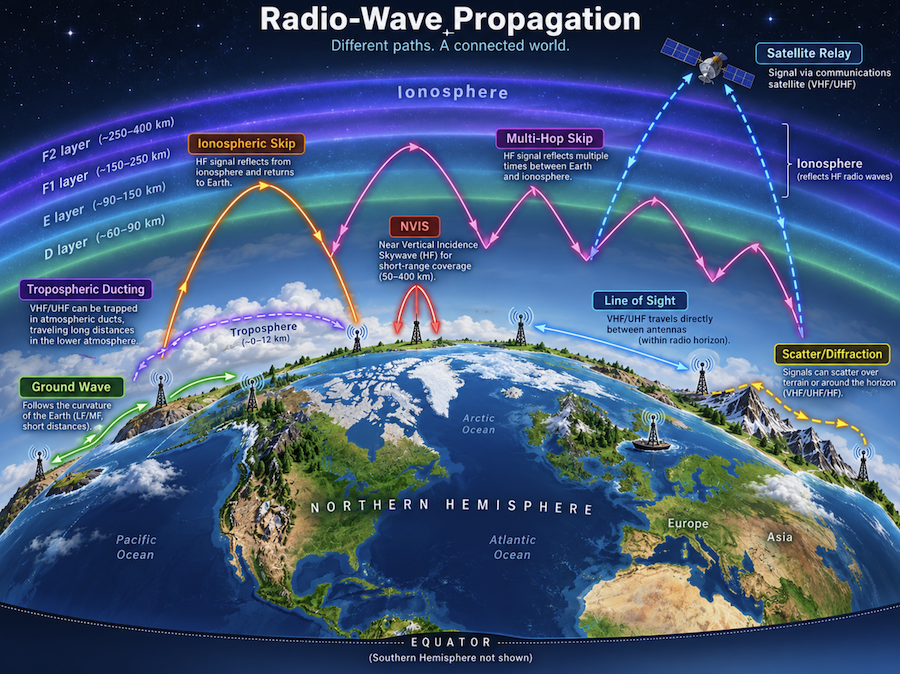
One of the most important parts of any amateur radio station is its antenna. Whether you are using a small handheld radio, communicating from your vehicle, or operating a powerful radio station at home, your antenna plays a major role in how far your signal travels and how clearly you can communicate. In fact, improving your antenna can sometimes make a greater difference than purchasing a more expensive radio. Amateur radio operators use many different antenna designs, each intended for particular frequencies, operating conditions, and communication needs. Some are small enough to fit in your pocket, while others stretch across entire backyards or stand on tall towers. Understanding the basic types of antennas will help you choose the right equipment and get the most from your amateur radio experience.
1. Handheld Radio Antennas
Rubber Duck Antennas: The Standard Handheld Antenna
Most handheld amateur radios, commonly called HTs or walkie-talkies, come equipped with a short, flexible antenna known as a rubber duck antenna. These antennas are usually made from a flexible material surrounding a metal conductor or a coiled radiating element. Their biggest advantages are convenience, portability, and durability. They are designed to work with the relatively low transmitting power of handheld radios, commonly around 1 to 5 watts, although some models offer higher output. Most are designed for the popular 2-meter VHF band, the 70-centimeter UHF band, or both. Their main disadvantage is limited efficiency. Because they are electrically short and often used close to the operator’s body, rubber duck antennas generally do not perform as well as larger antennas. They are perfectly suitable for many local communications, especially through nearby repeaters, but their range can be limited by buildings, terrain, and other obstacles.
Extended Whip and Telescoping Antennas: Improving Handheld Range
One of the easiest ways to improve handheld radio performance is to replace the original rubber duck antenna with a longer, more efficient whip antenna. These antennas may be made from flexible materials or telescoping metal sections that extend to a greater length. Common designs include quarter-wave and half-wave antennas, with the required physical length determined by the operating frequency. For example, a quarter-wave antenna for the 2-meter band is approximately 19 inches long, while a half-wave antenna is approximately 39 inches long. The actual length of a commercially manufactured antenna may differ because of its internal electrical design. Longer antennas can provide better transmission and reception under suitable conditions, although they may be less convenient to carry and can place additional stress on a handheld radio’s antenna connector. When purchasing a replacement, make sure it supports your intended frequencies and has the correct connector, such as SMA or BNC. Not every longer antenna will automatically outperform the original, so antenna quality and proper matching are important.
Roll-Up J-Pole and Portable Directional Antennas
For amateur radio operators who want improved performance while camping, hiking, or operating from temporary locations, portable antennas offer additional options. A popular example is the roll-up J-pole, often constructed from flexible twin-lead or ladder-line material. It can be rolled into a small package for transportation and then suspended vertically from a tree branch, mast, or other support. When properly installed, it can provide better performance than a handheld antenna, particularly because it can be positioned higher and away from the operator’s body. Another option is a portable Yagi antenna, a directional antenna with several metal elements mounted along a supporting boom. Unlike a typical handheld antenna that sends and receives signals in many horizontal directions, a Yagi concentrates its response in a particular direction. Portable Yagis are commonly used for satellite communications, radio direction finding, and reaching distant stations. These antennas generally connect to the handheld radio using coaxial cable, and operators must ensure the antenna is properly matched to the radio.
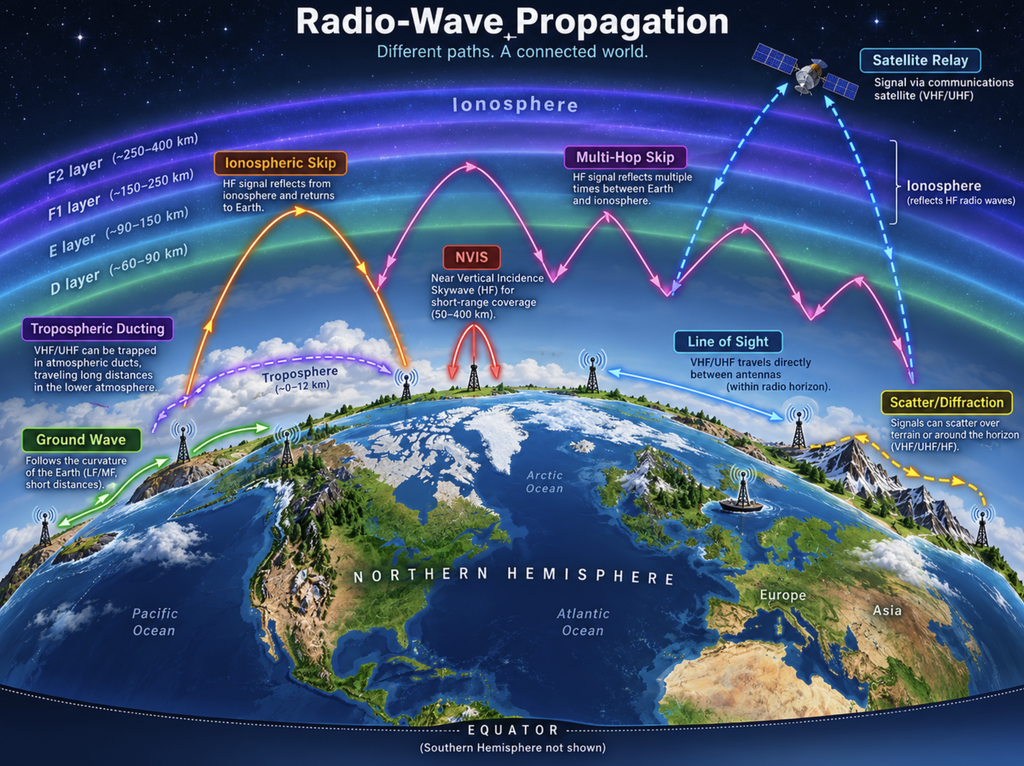
Image credit; K5SCI
2. Mobile Radio Antennas
Quarter-Wave and Five-Eighths-Wave Antennas: Popular Vehicle Choices
Mobile amateur radio antennas are designed for installation on cars, trucks, recreational vehicles, and other vehicles. Among the most common designs are quarter-wave and five-eighths-wave vertical antennas. A quarter-wave antenna is relatively short, affordable, durable, and effective for local VHF/UHF communication. Many quarter-wave mobile antennas rely on the metal body of the vehicle to serve as part of the antenna system, commonly called a ground plane. A five-eighths-wave antenna is longer and can provide additional gain toward the horizon under suitable conditions, making it attractive for communicating with distant repeaters or stations on relatively flat terrain. However, greater gain does not always mean better performance, especially in mountainous areas or where the desired signal arrives at a higher angle. Proper mounting location, antenna design, and the surrounding environment all affect performance. For many beginners, a properly installed quarter-wave antenna is an excellent starting point.
Dual-Band Mobile Antennas and Mounting Systems
Many modern amateur radio operators use mobile radios capable of transmitting on both the 2-meter and 70-centimeter bands. Dual-band antennas are specifically designed to operate efficiently on both frequency ranges without requiring the operator to change antennas. These antennas may use multiple radiating sections, coils, or other electrical components to achieve multiband operation. They are available in several lengths and designs, including models that offer additional gain. How the antenna is mounted is especially important. Popular mounting methods include magnetic mounts, permanent roof mounts, trunk-lip mounts, and brackets attached to other suitable vehicle locations. One widely used mounting standard is the NMO mount, which provides a secure and convenient antenna connection. A properly installed roof-mounted antenna near the center of a metal roof often provides favorable performance because of its elevated position and relatively uniform ground plane. Magnetic mounts are convenient because they usually do not require drilling, but their performance and reliability depend on proper installation. Operators should also consider antenna clearance, weather resistance, cable routing, and the possibility of damage when entering garages or parking structures.
HF Mobile Antennas: Communicating Beyond the Local Area
While VHF and UHF mobile antennas are commonly used for local communications, some amateur radio operators install high-frequency (HF) equipment in their vehicles to communicate over much greater distances. HF antennas are more challenging because their operating wavelengths are much longer. A full-size quarter-wave antenna for the 20-meter band, for example, would be approximately 16 to 17 feet long, making it impractical for many vehicles. To overcome this limitation, manufacturers offer shortened, electrically loaded antennas. One common design is the fixed-band loaded whip, sometimes called a Hamstick, which uses a loading coil to operate on a particular HF band. Another popular design is the screwdriver antenna, which contains a motorized adjustable loading coil that allows the operator to change its tuning across multiple HF bands. These antennas can provide impressive communication capabilities, but their performance depends heavily on installation quality, vehicle bonding, antenna placement, and proper tuning. HF mobile antennas often require greater attention to vehicle grounding and electrical noise than typical VHF/UHF systems.
3. Base Station Antennas
VHF/UHF Ground-Plane, J-Pole, and Collinear Antennas
A base station is a radio installation located at a fixed site, such as a home, office, or dedicated amateur radio room. For operators who primarily communicate locally through repeaters or directly with nearby stations, vertical VHF/UHF antennas are among the most popular choices. A ground-plane antenna typically consists of a vertical radiating element with several metal radials extending outward from its base. It is relatively inexpensive, easy to construct, and effective for communication in multiple horizontal directions. The J-pole is another popular design that can be made from metal tubing or wire and uses a matching section to connect to the radio’s feed line. Commercial fiberglass collinear antennas are also widely used. These contain multiple radiating sections arranged vertically to produce additional gain toward the horizon. Such antennas are frequently mounted on rooftops, masts, or towers. For local VHF/UHF communications, antenna height and a clear path toward the receiving station are often more important than simply increasing transmitter power.
Dipole and Fan Dipole Antennas: Affordable Options for HF Communications
The dipole is one of the simplest and most widely used antennas in amateur radio. A basic half-wave dipole consists of two conductive elements extending in opposite directions from a central feed point. These elements are typically made from wire and supported between trees, poles, or other structures. A dipole designed for the 40-meter amateur radio band, for example, is approximately 66 feet long overall, although the final dimensions must be adjusted for the actual installation. Dipoles are popular because they are inexpensive, relatively easy to construct, and capable of excellent performance. They can be installed horizontally, as an inverted V, or in other suitable arrangements. A variation called the fan dipole uses several pairs of wires connected to a common feed point, allowing operation on multiple amateur radio bands. These antennas are particularly attractive to new General-class licensees who want to explore HF voice and digital communication without investing in an expensive antenna system.
End-Fed Wire Antennas: Flexible Installations for Limited Space
End-fed antennas are another popular option for home and portable HF radio stations. Unlike a conventional dipole, which is normally fed at its center, an end-fed antenna is connected to the feed line near one end of its radiating wire. One common design is the end-fed half-wave antenna, usually abbreviated EFHW. With appropriate matching equipment, certain EFHW designs can operate on several harmonically related amateur radio bands. These antennas are convenient because a single long wire can be installed between a house and a tree, supported as an inverted L, or arranged in other configurations. Another design is the random-wire or nonresonant end-fed antenna, which generally requires a suitable matching transformer, an antenna tuner, and an appropriate counterpoise or grounding arrangement. Although these antennas are flexible, they must be installed carefully to control unwanted radio-frequency currents on the coaxial cable and equipment. Their actual performance depends on wire length, height, matching losses, and the surrounding environment.
Vertical HF Antennas and Magnetic Loop Antennas
Vertical antennas are frequently used by operators who want HF capability without installing long horizontal wires. A typical quarter-wave HF vertical uses a vertical radiating element and a system of ground radials or an elevated counterpoise. Some multiband designs use loading coils, traps, or other matching components to support several amateur radio bands. Their main advantages include a relatively small horizontal footprint and the ability to transmit and receive in multiple directions without rotating the antenna. However, a poor ground-radial system can significantly reduce efficiency. Another option for operators with limited space is the magnetic loop antenna. These antennas use a relatively small conductive loop and a tuning capacitor to resonate on selected frequencies. Magnetic loops can be useful for portable stations, patios, and other restricted spaces, but many have narrow operating bandwidths and require careful tuning. Their efficiency varies substantially with size, construction quality, and frequency. High voltages and RF exposure near transmitting loops also require special attention.
Yagi, Hexbeam, and Other Directional Base Station Antennas
Amateur radio operators who want greater control over their transmitted and received signals often use directional antennas. The Yagi antenna, sometimes called a beam antenna, uses several conductive elements to concentrate radio energy in a particular direction. Yagis are used on HF, VHF, and UHF frequencies and are popular for long-distance communication, contests, satellite operations, and weak-signal work. Many are mounted on towers with antenna rotators, allowing the operator to point the antenna toward a desired station. A similar HF design is the hexbeam, which uses wire elements supported by a lightweight frame. Hexbeams are popular among operators who want multiband directional performance with a smaller physical footprint than many traditional HF Yagis. Other directional designs include quad antennas, Moxon rectangles, and log-periodic antennas. These systems can offer significant advantages when contacting weak or distant stations, but they generally require more installation space, structural support, and expense than simple wire or vertical antennas.
4. Choosing the Right Antenna for Your Ham Radio Station
The best antenna depends on where you operate, which frequencies you intend to use, how much installation space is available, and what you want to accomplish. For someone beginning with a handheld Technician-class radio, an upgraded dual-band whip antenna may be sufficient for everyday local communications. An operator who spends considerable time driving may benefit from a properly installed dual-band mobile antenna. Someone setting up a home VHF/UHF station might choose an outdoor vertical or collinear antenna, while an operator interested in nationwide or international HF communications may begin with a wire dipole, end-fed antenna, or multiband vertical. Before purchasing an antenna, always check its intended frequency range, power-handling capacity, connector type, and installation requirements. Pay attention to the standing wave ratio (SWR), which indicates how well the antenna system’s impedance matches the transmission line and radio. Excessively high SWR can reduce effective performance and may cause some transmitters to automatically reduce their power. An antenna tuner can help the transmitter work into a mismatched antenna system, but it cannot eliminate every source of antenna or feed-line loss.
5. Antenna Safety, Grounding, and Proper Installation
Regardless of which antenna you choose, proper installation and safety should always come first. Outdoor antennas, masts, towers, and supporting wires must be kept well away from overhead electrical power lines. An antenna or mast contacting a power line can cause serious injury or death. Outdoor radio installations also require appropriate attention to electrical bonding, grounding, lightning protection, weatherproofing, and structural support. Operators should use coaxial cable suitable for their frequencies and installation length, because poor-quality or excessively long feed lines can waste transmitted power and weaken received signals. The FCC also requires amateur stations to comply with applicable radio-frequency exposure limits, making antenna placement and operating power important considerations. Building codes, property restrictions, and installation requirements may also apply. If you are unfamiliar with electrical grounding, tower installation, or lightning protection, seek guidance from an experienced amateur radio operator or qualified professional.
6. The Right Antenna Can Make All the Difference
A common saying among amateur radio enthusiasts is that the antenna is one of the most important investments in a radio station. A modest radio connected to a well-designed, properly installed antenna can sometimes outperform a much more expensive radio connected to an inefficient antenna. For beginners, the key is to start with equipment suited to their intended activities and gradually improve their antenna systems as they gain experience. There is no single antenna that works best for every frequency, location, or operating situation. Learning how different antennas function, experimenting with their placement, and understanding how radio signals travel are important parts of the amateur radio experience. Whether your goal is to communicate with local friends, participate in emergency communications, contact distant countries, or experiment with radio technology, the right antenna can open the door to an entirely new world of communication.
KI7QQC Amateur Radio | Exploring the World Through Radio
For additional information about amateur radio antennas, installation techniques, and safety, visit the American Radio Relay League (ARRL), including its antenna education and technical resources. Always follow applicable FCC regulations and safe antenna installation practices.