October 24, 2026 | KI7QQC Amateur Radio
Imagine being able to send text messages to friends, family members, or other radio operators without cellular service, Wi-Fi, or an internet connection. Now imagine those messages traveling across an entire city through a network of small, battery-powered radios, some installed on rooftops or hilltops. This is the technology behind Meshtastic and MeshCore, two increasingly popular wireless communication systems that use inexpensive radio equipment to create independent messaging networks. Both technologies are attracting attention from amateur radio enthusiasts, outdoor adventurers, emergency preparedness groups, and people interested in maintaining communications when conventional networks are unavailable. Although Meshtastic and MeshCore have similar purposes, they operate differently, and each offers advantages and disadvantages depending on how the network is built and used.
What Are Meshtastic and MeshCore?
Meshtastic and MeshCore are wireless messaging systems built around a radio technology called LoRa, short for Long Range. LoRa allows relatively small amounts of digital information to be transmitted over considerable distances using very little electrical power. Unlike a traditional amateur radio, which commonly transmits voice communications, these systems primarily transmit text messages and other small data packets. A typical setup includes a small radio device connected to a smartphone through Bluetooth. The user types a message into an application, and the radio transmits it over the air. Another compatible radio receives the transmission and delivers the message to its connected smartphone or computer. Some devices include built-in keyboards and displays, allowing them to operate without a smartphone.
Both systems use a concept called mesh networking. In a mesh network, messages can travel between several radio devices rather than requiring a direct connection between the sender and recipient. For example, someone located on one side of a city might send a message to another person several miles away. If the two radios cannot communicate directly, intermediate radio devices may relay the message until it reaches its destination. This process allows a properly designed network to cover much larger areas than a single radio could reach on its own. However, Meshtastic and MeshCore have different rules about which devices relay messages and how those messages move through the network.
Meshtastic: A Decentralized Network Where Ordinary Radios Help Each Other
Meshtastic is an open-source project that allows compatible LoRa radio devices to form decentralized wireless networks. Its most distinctive feature is that ordinary user radios can help relay messages for other users. By default, many Meshtastic devices operate as clients that both send and receive their own messages and participate in forwarding messages through the network. This means that several people carrying radios can help extend communications without necessarily installing dedicated repeater stations.
Meshtastic primarily uses a method known as managed flooding. When a message is transmitted, nearby nodes may rebroadcast it to extend its reach. The system attempts to prevent unnecessary duplicate transmissions and limits how many times a message can be forwarded. Newer Meshtastic firmware also uses learned next-hop routing for direct messages, helping reduce unnecessary retransmissions when a suitable path is known. As a result, Meshtastic can adapt to changes in network conditions while allowing ordinary portable devices to contribute to the network.
For example, consider five people hiking through a large state park. Each carries a Meshtastic radio paired with a smartphone. If the first and fifth hikers are too far apart to communicate directly, the devices carried by the hikers between them may relay messages through the group. As people move, the network can attempt to find alternative routes. This makes Meshtastic attractive for portable activities where participants are moving and permanent communication infrastructure may not exist.
Benefits of Meshtastic
One of Meshtastic’s greatest advantages is its flexibility. Users can create small networks with relatively little infrastructure, and compatible devices can often begin communicating once they are configured with matching radio settings. Meshtastic also benefits from a relatively established ecosystem of hardware, software, and community support. Applications are available for smartphones and computers, and the system supports features such as GPS position sharing, device telemetry, private messaging, and customizable communication channels.
Another benefit is its optional internet connectivity. Meshtastic supports MQTT, a messaging technology that allows properly configured internet-connected gateways to link otherwise separate radio networks. For example, two groups of operators in different cities may communicate through an internet bridge, even when a direct radio connection is impossible. However, this feature depends on internet connectivity and should not be confused with completely independent, radio-only communication.
Disadvantages of Meshtastic
Meshtastic’s greatest strength can also become one of its weaknesses. Because many ordinary devices participate in relaying traffic, busy networks may experience additional radio transmissions, congestion, and message collisions. LoRa is designed for relatively small amounts of data rather than high-speed communications, so excessive network traffic can reduce overall performance. Meshtastic includes mechanisms to limit unnecessary transmissions, but dense networks still require careful configuration.
Another limitation involves the number of forwarding steps, commonly called hops. Meshtastic normally uses a default hop limit of three, although it can be configured for a maximum of seven. This can restrict how far a message travels through an extended network, particularly in areas where individual radio links are relatively short. Additionally, a network that depends on portable radios may change frequently as users move, turn off their devices, or leave the area. Messages can be delayed or lost when a reliable path is unavailable. Meshtastic is also not a guaranteed messaging service, and its delivery behavior should not be confused with ordinary cellular text messaging.
MeshCore: A Network Designed Around Dedicated Repeaters
MeshCore is another wireless messaging system built around LoRa technology, but it approaches networking differently. Instead of expecting ordinary user devices to relay messages for everyone, MeshCore is organized around specific device roles. A personal radio typically operates as a companion node, while separate devices operate as dedicated repeaters or room servers.
A companion node allows its owner to send and receive messages but does not normally retransmit messages for unrelated users. Dedicated MeshCore repeaters provide the infrastructure needed to extend communications across a larger area. These repeaters can be installed on rooftops, towers, hilltops, or other elevated locations. Some operators use solar panels and batteries to keep repeaters operating continuously without commercial electrical power.
MeshCore also uses a different approach to routing direct messages. When a route to another user is not known, an initial message can be distributed through the network to discover a working path. After that path is learned, later direct messages can travel through a more specific sequence of repeaters. This reduces the number of devices that must retransmit each message. Group and channel messages still use flooding through eligible repeaters because they are intended for multiple recipients rather than one specific destination.
For example, imagine a city with several MeshCore repeaters installed on tall buildings. A person downtown sends a message to someone in a distant suburb. Instead of having every nearby handheld device attempt to forward the message, the network uses its repeater infrastructure to deliver it. Once a suitable route is known, future direct messages can follow that route more efficiently.
Benefits of MeshCore
MeshCore’s main advantage is its ability to make efficient use of limited radio bandwidth when reliable repeater infrastructure is available. Because ordinary companion devices do not automatically retransmit traffic for other users, fewer unnecessary transmissions may occur. This can reduce network congestion and improve responsiveness, particularly in larger networks where repeaters have been strategically positioned.
MeshCore also supports a feature called a room server. A room server can store messages so users can retrieve them later when they reconnect. This differs from ordinary real-time group messaging, where a message may be missed if the intended recipient is outside network coverage when it is transmitted. Room servers provide a useful option for community announcements, message boards, and other communications where users may not remain connected continuously.
Another advantage is MeshCore’s support for longer repeater paths. Depending on the addressing configuration, MeshCore can support paths containing substantially more hops than the standard Meshtastic limit. In some configurations, its theoretical maximum reaches 64 hops. However, this does not mean that every network can reliably deliver messages across 64 repeaters. Real-world performance depends on coverage, radio conditions, available bandwidth, congestion, and repeater configuration.
Disadvantages of MeshCore
MeshCore’s principal disadvantage is its greater dependence on dedicated repeater infrastructure for extended multi-hop coverage. If two users are outside direct radio range and no suitable repeater connects them, their messages may not reach each other. Unlike Meshtastic, simply adding more ordinary companion devices does not necessarily extend the network because those devices are not designed to relay traffic.
Creating a large MeshCore network may therefore require additional planning, equipment, installation locations, and ongoing maintenance. Repeaters placed at useful elevations can require weatherproof enclosures, reliable power supplies, antennas, mounting hardware, and suitable site permissions. Although some communities already have established repeater networks, people living in areas without existing MeshCore infrastructure may need to build their own.
MeshCore also has a smaller and newer software ecosystem than Meshtastic in many areas, although development and adoption have been expanding. Some advanced administration features in particular applications may require optional paid unlocks. The underlying MeshCore firmware remains freely available, but users should review the features and licensing terms of their chosen applications and hardware.
Meshtastic vs. MeshCore: Comparing the Two Systems
Although both technologies can provide independent wireless messaging, their different networking designs make them better suited for different operating environments.
| Feature | Meshtastic | MeshCore |
|---|---|---|
| Primary purpose | Off-grid messaging and data | Off-grid messaging and data |
| Radio technology | LoRa | LoRa |
| Cellular service required | No | No |
| Internet required | No | No |
| Ordinary user devices relay messages | Usually yes, depending on settings | No, companion nodes do not normally relay |
| Dedicated repeaters | Optional | Important for extended mesh coverage |
| Routing | Managed flooding and learned next-hop direct messaging | Learned paths for direct messages; flooding for group messages |
| Maximum hop count | Normally 7 | Up to 64 in certain configurations |
| Private messaging | Supported | Supported |
| GPS and telemetry | Extensive support | Available features depend on hardware and software |
| Stored message boards | Limited optional store-and-forward capabilities | Dedicated room server feature |
| Mobile activities | Well suited to changing groups | Useful, especially with nearby repeaters |
| Large fixed networks | Possible, requires traffic management | Designed for planned repeater networks |
| Hardware compatibility | Broad device support | Growing range of compatible devices |
| Compatible with the other system | No | No |
The two technologies cannot communicate directly with one another simply because they use the same frequency band or similar hardware. They use different protocols and message formats. Some LoRa devices can be reprogrammed to run either Meshtastic or MeshCore, but a radio running one system generally cannot communicate with a radio running the other without additional bridging equipment or software.
How Far Can Meshtastic and MeshCore Communicate?
One of the most common questions about these systems concerns their range. Unfortunately, there is no single answer. Both technologies use LoRa radio signals, and their range depends heavily on antenna design, antenna height, terrain, buildings, interference, transmitter power, receiver sensitivity, and radio configuration.
Two handheld devices operating at ground level in a dense urban environment may communicate over only a limited distance, especially when buildings or terrain obstruct their signals. In more favorable conditions, communication over several miles may be possible. With elevated antennas and a clear radio path, individual connections can extend much farther. Exceptionally long LoRa contacts have been demonstrated under favorable conditions, but these should not be treated as ordinary operating expectations.
For both systems, a properly located repeater can make an enormous difference. A radio installed on a tall building or hilltop may communicate with devices that cannot hear one another directly. However, neither Meshtastic nor MeshCore automatically guarantees citywide coverage. The existence, placement, and reliability of participating devices ultimately determine the usable network.
Privacy, Encryption, and Security
Both Meshtastic and MeshCore support encrypted communications, allowing users to create private messaging channels or exchange direct messages. However, encryption does not mean every message is automatically confidential.
Meshtastic supports encrypted group channels and direct messages using cryptographic keys. Anyone who possesses a group’s shared channel key can read messages on that channel. The default public Meshtastic channel uses a publicly known key, so messages transmitted on it should be considered public rather than private.
MeshCore also supports private messaging and encrypted group channels. Its default public channel uses a publicly known key, and named public channels may use keys derived from their names. Those channels should not be considered confidential merely because their transmissions are technically encrypted. Private channels require appropriately protected secret keys.
Both systems can expose certain information through message headers, network advertisements, location-sharing settings, or connected services. Users should avoid sending highly sensitive information without understanding the security limitations of the particular system and software version.
Do You Need an FCC Amateur Radio License?
One important point is that neither Meshtastic nor MeshCore normally requires an amateur radio license in the United States when operated using compliant unlicensed radio equipment under FCC Part 15 rules.
Most American users operate compatible devices within the 902–928 MHz frequency range, commonly referred to as the 915 MHz band. This spectrum can be used by qualifying unlicensed devices, provided the equipment and its operation comply with applicable FCC requirements.
The fact that a radio operates within this frequency range does not mean every transmitter, power setting, or antenna configuration is automatically legal. Users must ensure their equipment complies with the applicable technical and equipment authorization requirements. Part 15 devices must also avoid causing harmful interference and must accept interference from other authorized radio operations.
The distinction between Part 15 operation and licensed amateur radio operation is especially important for encryption. FCC amateur radio rules generally prohibit transmitting messages encoded for the purpose of obscuring their meaning, subject to limited exceptions. Therefore, operators should not assume that an encrypted Meshtastic or MeshCore configuration is automatically lawful when operated under an amateur radio license rather than under the applicable unlicensed equipment rules.
Can These Systems Be Used During Emergencies?
Emergency preparedness is one of the reasons these technologies have attracted considerable interest. A battery-powered LoRa radio can continue sending messages even when cellular towers, commercial internet providers, and electrical power systems are unavailable, provided a usable radio path remains.
For example, a family could establish a small Meshtastic network connecting several households. A neighborhood organization could use MeshCore repeaters installed at suitable locations to create a larger community messaging system. Portable solar panels, rechargeable batteries, and low-power radio equipment can help keep individual stations operating during extended power outages.
However, neither system should be viewed as a guaranteed emergency communication service. Messages may fail because of interference, equipment damage, battery failure, network congestion, insufficient coverage, or unavailable repeaters. These systems generally do not provide ordinary voice calls or direct access to 911.
For serious emergency preparedness, Meshtastic or MeshCore should be considered an additional communication option rather than a replacement for cellular service, licensed amateur radio, public safety radio systems, or satellite-based emergency communication devices.
Which System Is Better for You?
For people who want a portable messaging network that can be assembled quickly, Meshtastic offers important advantages. Its decentralized design allows ordinary user devices to participate in relaying messages, making it particularly attractive for hiking groups, camping trips, outdoor activities, and small networks where users regularly move between locations. Its established software ecosystem and support for GPS and telemetry are additional benefits.
For people interested in building a more organized community network, MeshCore may be the better choice. Its separation of companion devices and dedicated repeaters can improve efficiency, particularly when the network serves a large geographic area. MeshCore is especially attractive when community volunteers can install and maintain reliable repeater locations. Its learned-path routing and room server capabilities provide additional benefits for larger messaging networks.
Perhaps the most important consideration is which technology is already being used in your area. A Meshtastic radio offers little practical community connectivity if everyone nearby is using MeshCore, and the opposite is equally true. Before purchasing equipment, investigate local mesh networking groups and determine which protocol, radio settings, and repeaters are already established.
The Future of Independent Digital Radio Communications
Meshtastic and MeshCore represent an interesting development in the history of wireless communications. Both demonstrate that relatively inexpensive, low-power radio equipment can be used to build useful communication networks independently of traditional cellular and internet infrastructure.
Their greatest differences lie not in the underlying radio technology but in their approaches to networking. Meshtastic emphasizes decentralized participation, allowing ordinary devices to help forward communications. MeshCore emphasizes more deliberate network organization, using dedicated repeaters and learned routing paths to support efficient messaging.
Neither system is necessarily superior in every situation. Meshtastic offers flexibility and a broad ecosystem, while MeshCore provides an attractive architecture for organized repeater-based networks. Both still face limitations involving bandwidth, equipment, coverage, interference, and message reliability.
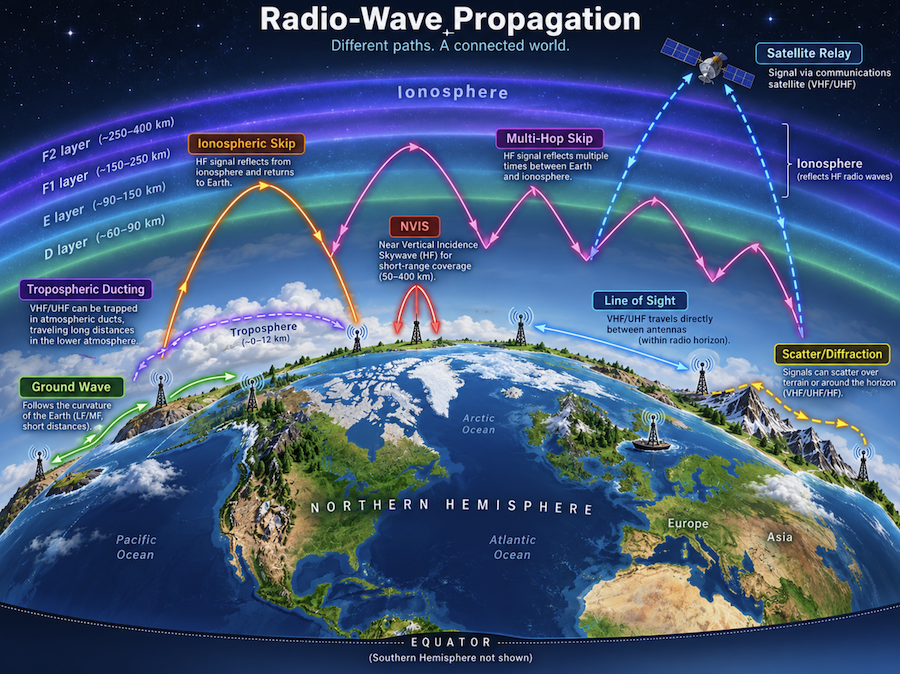
For amateur radio enthusiasts, these technologies offer another opportunity to experiment with antennas, digital communications, propagation, networking, and independent communications infrastructure. For the general public, they provide a relatively accessible introduction to radio technology without necessarily requiring an FCC amateur radio license.
As both systems continue to develop, their success will depend not only on better firmware and hardware but also on the communities willing to install equipment, maintain networks, and help new users participate.
KI7QQC Amateur Radio | Exploring Independent Wireless Communications
K5SCI contributed to this article.
For more information, visit the official Meshtastic website or the MeshCore website. Both projects provide documentation, compatible hardware information, software downloads, and instructions for establishing a wireless messaging network.
Technical features and regulatory requirements are subject to change. Users should verify current software capabilities, hardware compatibility, and applicable FCC regulations before operating radio equipment.